Some professional relationships demonstrate that infrastructure management is more art than science. When a web hosting company contacted me about email problems disrupting their business, neither of us imagined we were beginning a partnership that would span over a decade, evolve through multiple technology generations, and culminate in a graceful business transition.
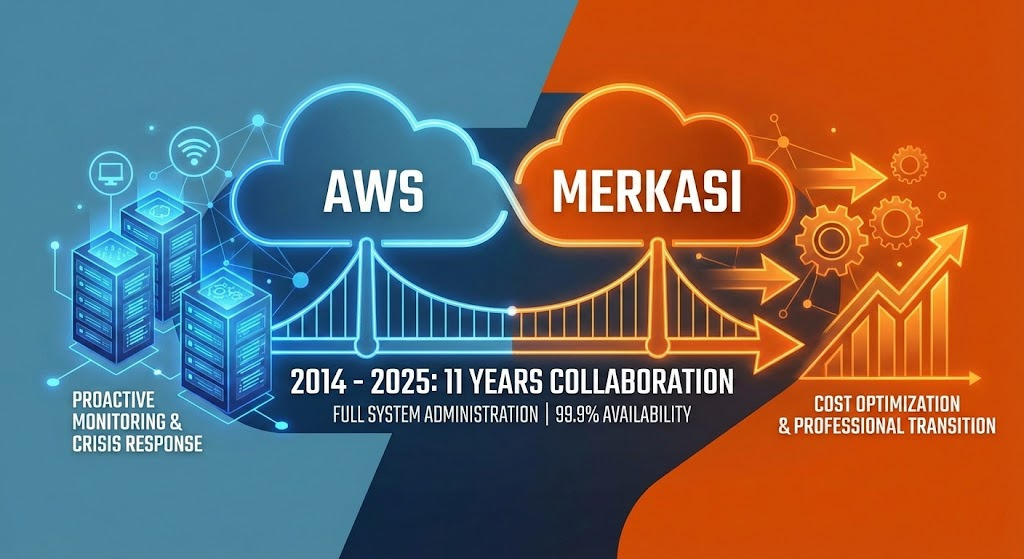
What started as urgent troubleshooting evolved into complete AWS infrastructure stewardship—monthly maintenance services, 24/7 crisis response, infrastructure modernization, cost optimization, and eventually a professional knowledge transfer when the business owner decided to pursue a new career path. Over 11 years, the infrastructure grew from a single server to a sophisticated multi-region AWS environment, always prioritizing business continuity over architectural perfection.
When Pragmatism Beats Perfection
The relationship began with what every hosting company dreads: legitimate emails mysteriously landing in spam folders despite proper whitelisting. Multiple security systems were fighting each other rather than protecting users, and the client’s operations suffered while customers complained.
Instead of pursuing a perfect architectural solution that would take weeks, I built a pragmatic automation that immediately restored business operations. A lightweight script rescued misclassified emails and delivered them correctly while we investigated the root cause. The client appreciated this philosophy: business continuity first, theoretical perfection second.
The Philosophy That Guided 11 Years
”At the end of the day, the client just wants to avoid checking spam folders every few hours. If the workaround solves that immediately, it’s the right solution—even if it’s not the textbook answer.”
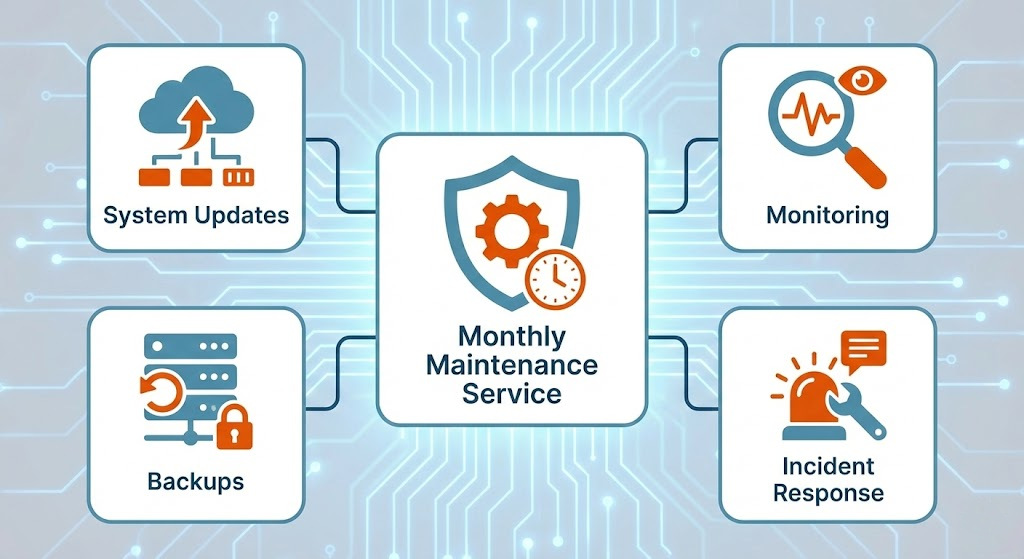
This successful crisis resolution led to a formalized partnership providing comprehensive system administration for the growing AWS infrastructure. The monthly service covered security updates, proactive monitoring, backup management, and rapid incident response—all at predictable costs that small hosting businesses could afford.
The Art of Proactive Infrastructure Management
Preventing Crises Before They Happen
The real value of long-term infrastructure partnerships shows in problems that never impact business operations. Comprehensive monitoring caught resource exhaustion before websites crashed, identified security compromises before data leaked, and detected cost anomalies before budgets exploded.
When compromised websites started sending spam and domains appeared on blacklists, rapid malware cleanup and vulnerability patching contained the threat within hours—preventing business-wide email delivery disruption.
Systematic investigation of mysterious resource saturation revealed unexpected root causes—like massive legacy backup files consuming critical disk space—before they caused cascading failures.
One particularly memorable crisis involved a domain appearing on spam blacklists, threatening email deliverability for dozens of hosted clients. Security tools identified compromised files sending spam, but the real challenge was restoring reputation with blacklist operators while maintaining business operations. Within hours, malicious files were removed, vulnerabilities patched, and delisting procedures initiated—preventing what could have been a catastrophic business disruption.
When Costs Spiral Out of Control
Infrastructure costs can grow organically over time as well-intentioned decisions accumulate into expensive inefficiency. A comprehensive cost analysis revealed that backup services were consuming over 70% of total AWS spending. Aggressive snapshot schedules and redundant geographic backups had accumulated over the years, each decision made sense individually but collectively created an expensive monster.
We rationalized the backup strategy by reducing snapshot frequency, eliminating redundant backup servers, and matching protection levels to actual business risk rather than theoretical maximum safety. The optimization cut costs by 30% while maintaining appropriate data protection for realistic disaster scenarios. Sometimes the best infrastructure decision is removing unnecessary complexity.
The Never-Ending Battle: Email Deliverability
For hosting companies, email is the invisible infrastructure that clients notice only when it breaks. Over 11 years, a significant portion of my work focused on the delicate balance between blocking spam aggressively enough to prevent blacklisting, while ensuring legitimate business emails always reached their destinations.
Building a Fortress Without Blocking Your Own Doors
Email security is a constant arms race. The challenge isn’t just blocking malicious emails—it’s doing so without creating false positives that disrupt legitimate business communications. The infrastructure combined multiple security layers working in harmony:
Multiple filtering layers caught spam before it reached inboxes, with continuous rule tuning to adapt to evolving attack patterns without blocking legitimate senders.
SPF, DKIM, and DMARC configurations proved domain authenticity to receiving servers, dramatically improving deliverability to major email providers.
Continuous monitoring of blacklist status, rapid delisting procedures, and sender reputation maintenance ensured consistent email deliverability.
The real complexity came from balancing security strictness with business reality. Corporate email systems, marketing platforms, and automated notifications often triggered spam filters despite being completely legitimate. Each case required careful analysis: was this a threat to block or a false positive to whitelist?
When Legitimate Emails Look Like Spam
Modern email authentication standards sometimes conflict with legitimate business email flows. Companies sending through third-party services, corporate email relays, or automated systems can fail authentication checks despite being entirely legitimate.
I developed systematic approaches for identifying and resolving these conflicts: analyzing email headers to understand authentication failures, configuring exceptions for known legitimate senders, and implementing selective filtering that maintained security without disrupting business operations. The goal wasn’t maximum security—it was maximum business value, which meant emails that should reach their destinations always did.
Engineering for Real-World Constraints
The Legacy Device Challenge
One of the most elegant technical solutions involved industrial equipment from the 1990s that needed to send email notifications. These legacy devices couldn’t handle modern authentication, encryption, or sender verification—yet they needed to work with cloud email services enforcing strict security policies.
The solution combined three technologies into an invisible translation layer: stunnel created encrypted tunnels providing the SSL/TLS security the old devices couldn’t implement, Postfix acted as an intelligent relay handling authentication and routing, and custom header-rewriting scripts automatically transformed outgoing messages to meet Amazon SES verification requirements. The devices continued using simple SMTP as they always had, completely unaware of the sophisticated infrastructure translating their ancient protocols into modern cloud services.

This wasn’t just technical elegance for its own sake—it solved a real business problem where replacing functioning industrial equipment would have cost tens of thousands of euros, while the software solution worked reliably for years at virtually no cost.
When Migration Means Evolution, Not Revolution
As web technology evolved, newer applications demanded modern runtime environments incompatible with aging production servers. But complete server replacement risked email disruptions across dozens of hosted clients—a risk the business couldn’t afford.
The solution avoided an all-or-nothing migration by running modern and legacy infrastructure in parallel. New servers handled contemporary applications while email services remained on proven stable systems. DNS configuration intelligently split traffic—web requests to new servers, email to legacy infrastructure—enabling gradual migration without business disruption.
Websites migrated progressively to modern environments while email remained untouched. Clients experienced zero downtime, and the business avoided the classic migration disaster of “everything breaks simultaneously.” Business continuity trumped architectural purity every time.
A Decade of Trust and Evolution
What Makes Long-Term Partnerships Work
Infrastructure relationships spanning over a decade reveal patterns about what actually matters in production environments:
The infrastructure grew from a single server to a sophisticated multi-region AWS environment. Each expansion came not from arbitrary planning but from solving real business problems: security incidents that demanded better monitoring, resource constraints that required scaling strategies, technology evolution that needed modern platforms while maintaining legacy compatibility.
Professional Closure
When the business owner decided to close the hosting company and pursue a new career after more than a decade, the partnership concluded as professionally as it began. Comprehensive documentation of complex configurations, complete server access for the new provider, and availability during the transition ensured zero disruption for hosted clients.
The True Test of Professional Relationships
The partnership concluded with complete knowledge transfer, satisfied clients experiencing zero disruption, and mutual respect between professionals who had navigated a decade of technical challenges together. That’s how professional relationships should end.
The new hosting provider inherited functioning systems they could understand and maintain, clients noticed no change in service quality, and the business owner transitioned to his new career with confidence that his former clients remained in good hands.
What 11 Years Delivered
Crisis management when it mattered: Security breaches contained within hours. Blacklist situations resolved before widespread email disruption. Resource exhaustion caught before websites crashed. The value of long-term partnerships shows most clearly during crises.
Infrastructure that evolved with needs: From legacy environments to modern platforms, simple protocols to sophisticated cloud integration, reactive firefighting to proactive monitoring and cost optimization. The infrastructure grew alongside the business without disruptive replacements.
Knowledge that transferred seamlessly: When the business closed after 11 years, comprehensive documentation and professional handover ensured clients experienced zero disruption. The new provider inherited functioning systems they could understand and maintain.
The Lessons of a Decade
Trust isn’t built through perfect implementations—it’s built through consistent reliability when things go wrong. Proactive monitoring prevented more problems than reactive firefighting ever solved. Infrastructure evolved continuously or became obsolete. And when the partnership ended, professional closure ensured everyone moved forward successfully.
That’s what long-term infrastructure relationships deliver: not just uptime and cost optimization, but the confidence that someone understands your systems deeply enough to keep them running, evolve them appropriately, and eventually transfer that knowledge professionally when circumstances change.
Need reliable long-term infrastructure partnership?
For hosting companies, digital agencies, and businesses requiring comprehensive system administration:
- AWS infrastructure management with proactive monitoring and cost optimization.
- Complex email infrastructure including cloud service integration and legacy system support.
- Security incident response for blacklist management, malware cleanup, and vulnerability patching.
- Server migrations and modernization prioritizing business continuity.
- Crisis management and troubleshooting for critical production systems.
- Monthly maintenance services providing predictable costs and rapid response.
With 20+ years of Linux system administration and AWS infrastructure experience, I provide the reliable, long-term infrastructure partnership that businesses depend on for continuity and evolution.
Get in touch →

About the author
Daniel López Azaña
Tech entrepreneur and cloud architect with over 20 years of experience transforming infrastructures and automating processes. Specialist in AI/LLM integration, Rust and Python development, and AWS & GCP architecture. Restless mind, idea generator, and passionate about technological innovation and AI.
Related projects

AWS Infrastructure Security with Advanced Bastion Host, 2FA and Access Auditing
Implementation of AWS security architecture with bastion host as single entry point, two-factor authentication with Google Authenticator, role-based access control, encrypted SSH tunnels for internal services and complete session recording system for regulatory compliance.
Témpolo Motor - Complete AWS Cloud Infrastructure
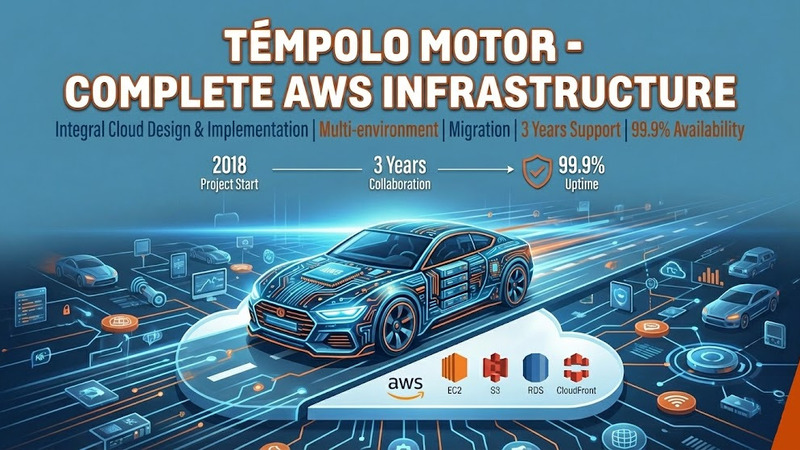
Comprehensive AWS cloud infrastructure design and deployment for automotive review platform Témpolo Motor, including multi-environment server architecture, domain migration, and 3 years of continuous technical support with 99.9% uptime.
Verasia - AWS Infrastructure for Language Learning Portals
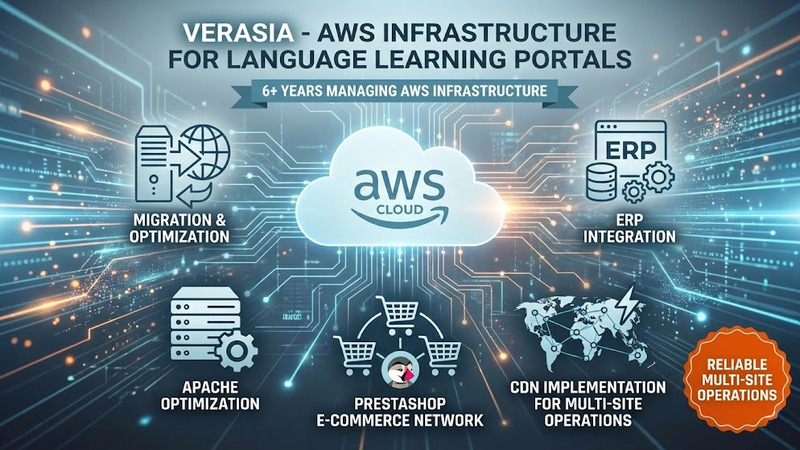
6 years managing AWS infrastructure for Verasia's PrestaShop e-commerce network. Migration, Apache optimization, ERP integration, and CDN implementation for reliable multi-site operations.
Comments
Submit comment