Project Context
When I joined Domestika in November 2017, the creative learning platform was a rapidly growing startup with barely 20 employees. As their first dedicated cloud architect and DevOps engineer, I assumed responsibility for building and maintaining the entire cloud infrastructure that would support the company’s explosive growth over the following three years. I eventually became Head of Infrastructure as the team expanded.
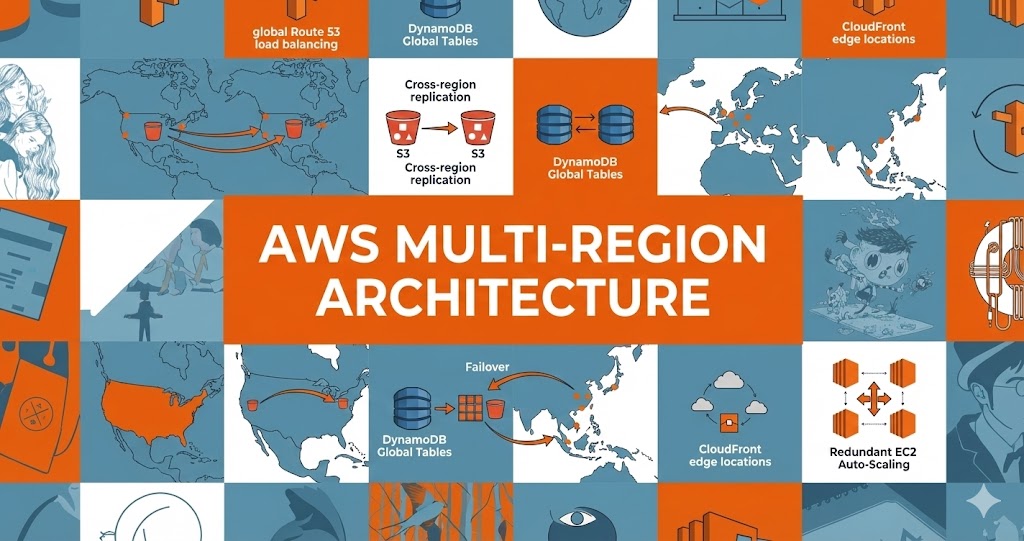
During my engagement, the company evolved from an operation centered in Spain and Latin America to become a global platform that achieved unicorn status with a valuation exceeding $1 billion and hundreds of employees. The infrastructure I designed and maintained was fundamental in supporting this growth, scaling from thousands to millions of users without compromising stability or performance.
By October 2020, the company had reached such scale and maturity that I concluded my mission was complete. I decided to move on, as I thrive on the challenge of growing smaller companies and startups where the impact of my work is more immediate and tangible, rather than working in large, well-established organizations.
Technical Challenge
Domestika faced several critical challenges requiring immediate solutions and long-term strategic planning:
Architecture and Implemented Solutions
Infrastructure as Code and Multi-Region Architecture
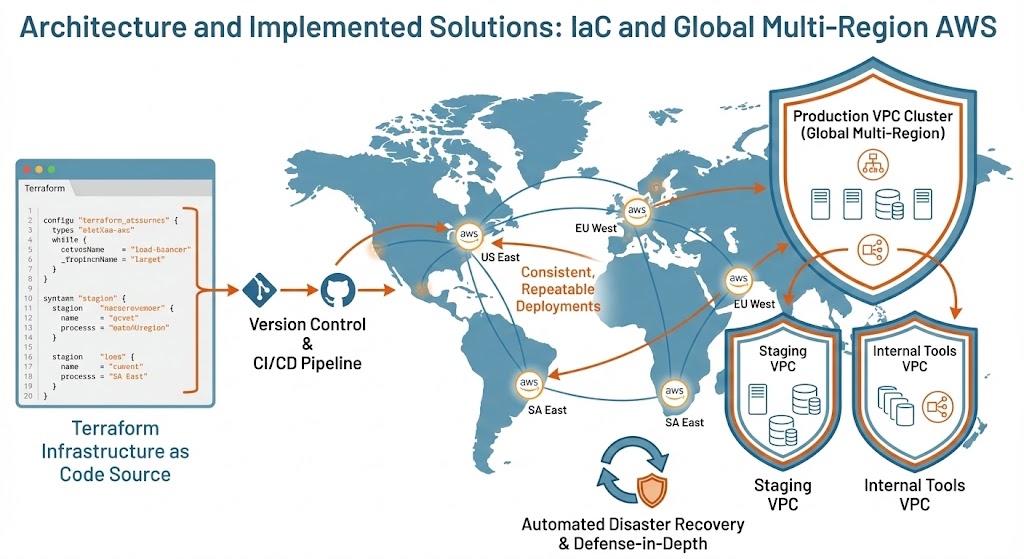
I designed and implemented a multi-region AWS architecture completely managed through Terraform, providing complete version control of all infrastructure changes and enabling consistent, repeatable deployments. Initially centered on serving Spain and Latin America, the architecture evolved to provide global support as the company expanded internationally.
The network strategy included custom VPC configurations for each environment (production, staging, and internal) with proper segmentation, implementing defense-in-depth security through security groups and network ACLs. This solid infrastructure-as-code foundation facilitated collaboration as the team grew and enabled automated disaster recovery through infrastructure recreation.
Multimedia Content Delivery Optimization
One of the most impactful projects was optimizing the platform’s image management and delivery system. Domestika hosted millions of high-resolution images from courses and creative projects that consumed excessive bandwidth and generated significant costs.
Initially, I developed an internal image processing system using a serverless pipeline with CloudFront CDN, processing queues, and automated optimization scripts with ImageMagick and MozJPEG. This system intercepted requests for unoptimized images, processed them on demand, and served them through CloudFront’s edge location network.
Later, as the company’s needs evolved and the image catalog grew exponentially, I migrated the entire system to Cloudinary, a specialized media management platform offering advanced capabilities perfectly aligned with Domestika’s needs. This migration significantly simplified the architecture while improving performance and reducing operational costs.
Database Management and Critical Migrations
I led the upgrade of production databases from MySQL 5.7 to 8.0, a complex project requiring extensive staging environment testing, careful query compatibility analysis, and coordinated migration windows with a minimal downtime approach.
I implemented a robust replication architecture with master-replica configuration for read scaling and a dedicated backup replica for point-in-time recovery capability. I developed intelligent scripts that automatically paused replication during backup windows and calculated optimal Datadog alert suppression times based on historical backup duration, preventing false alerts while maintaining monitoring coverage.
Security and Access
I implemented AWS WAF (Web Application Firewall) protecting against SQL injection attacks, XSS, and DDoS through custom pattern sets and rate limiting. I designed a bastion host system for secure access to internal infrastructure with automated user provisioning, SSH key management, comprehensive audit logging, and two-factor authentication for sensitive systems.
Network security implemented defense-in-depth with custom firewall configurations, security groups following least-privilege principles, segmentation between application tiers, and VPN access for remote team members.
DevOps and Automation
I configured and maintained complete CI/CD infrastructure with Jenkins, automating builds triggered by Git commits, deployment pipelines for staging and production, integration with AWS CodeDeploy, post-deployment health checks with automatic rollback, and error tracking.
I developed Lambda functions for serverless automation including dynamic EC2 instance management based on load, centralized logging, automated Elasticsearch index lifecycle management, and dynamic security group updates. I also created custom CLI tools that dramatically simplified common operations, reducing multi-step administrative tasks to single commands.
Monitoring and Observability
I implemented comprehensive monitoring with Datadog covering all infrastructure (EC2, RDS, ElastiCache, Elasticsearch, load balancers) and applications (Ruby on Rails, Sidekiq queues, web servers, background jobs). I developed custom checks with intelligent thresholds and created an alerting system with automated suppression during maintenance windows, dynamic thresholds based on historical patterns, and PagerDuty integration for on-call rotation.
Disaster Recovery
I developed a comprehensive snapshot system with daily EBS volume backups for all critical instances, automated retention management, and cross-region replication. I implemented multi-layered S3 content protection with recursive synchronization to backup storage, concurrent transfer management, and regular restore testing validating integrity.
I provided multiple database recovery strategies including full restoration from compressed exports, point-in-time recovery using binary logs, and snapshot-based rapid recovery, each with documented RTO and RPO.
Technologies Used
Cloud Platform: AWS (EC2, RDS, ElastiCache, Elasticsearch, S3, CloudFront, Route53, VPC, Lambda, DynamoDB, WAF).
Infrastructure as Code: Terraform, Git.
Application Stack: Ruby on Rails, Unicorn, Puma, Sidekiq, Redis, MySQL 8, Elasticsearch.
Media Optimization: Cloudinary (production), ImageMagick, MozJPEG (initial system).
CI/CD & Automation: Jenkins, AWS CodeDeploy, Python and Bash scripts, Lambda.
Monitoring: Datadog, PagerDuty.
Impact and Results
This experience reinforced the importance of building for scale from the beginning, investing in automation early, and maintaining a security-first mindset in all architectural decisions. Working with Domestika during this critical growth phase provided invaluable experience in cloud architecture, DevOps practices, and building infrastructure that truly enables business success.
Looking to build something similar?
For businesses experiencing rapid growth and needing scalable cloud infrastructure that handles:
- Multi-region deployments with low-latency content delivery worldwide.
- Infrastructure as Code for version-controlled, repeatable infrastructure.
- Automated CI/CD pipelines with zero-downtime deployments.
- Comprehensive monitoring and alerting for proactive incident management.
- Cost-effective media optimization at scale.
The AWS + Terraform + DevOps automation stack shown in the Domestika example provides a battle-tested foundation for high-growth platforms.
I’m available for consulting and development on similar infrastructure modernization projects, helping you build scalable, secure, and cost-effective cloud architectures that enable business success.
Get in touch →

About the author
Daniel López Azaña
Tech entrepreneur and cloud architect with over 20 years of experience transforming infrastructures and automating processes. Specialist in AI/LLM integration, Rust and Python development, and AWS & GCP architecture. Restless mind, idea generator, and passionate about technological innovation and AI.
Related projects
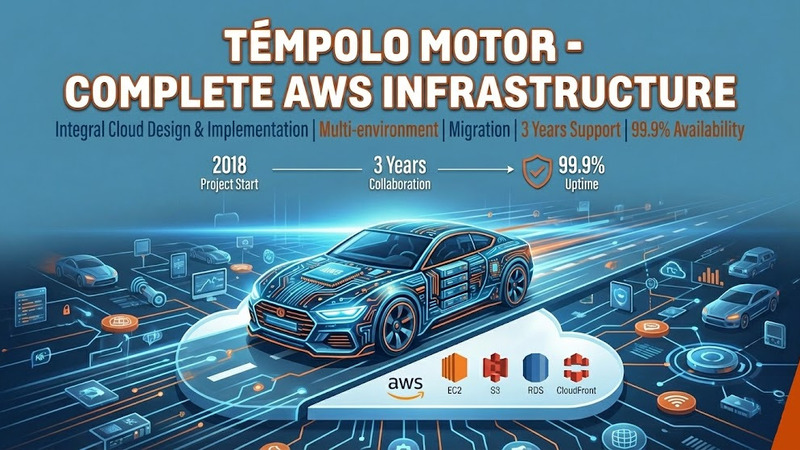
Témpolo Motor - Complete AWS Cloud Infrastructure
Comprehensive AWS cloud infrastructure design and deployment for automotive review platform Témpolo Motor, including multi-environment server architecture, domain migration, and 3 years of continuous technical support with 99.9% uptime.
AWS Cloud Architecture Consulting - Enterprise Solutions for Multiple Industries
Independent AWS cloud architecture consulting providing strategic guidance and technical leadership in designing and implementing innovative cloud infrastructure solutions for diverse clients across multiple industries, specializing in architectural design, deployment, optimization, security, compliance, cost management and CI/CD practices.
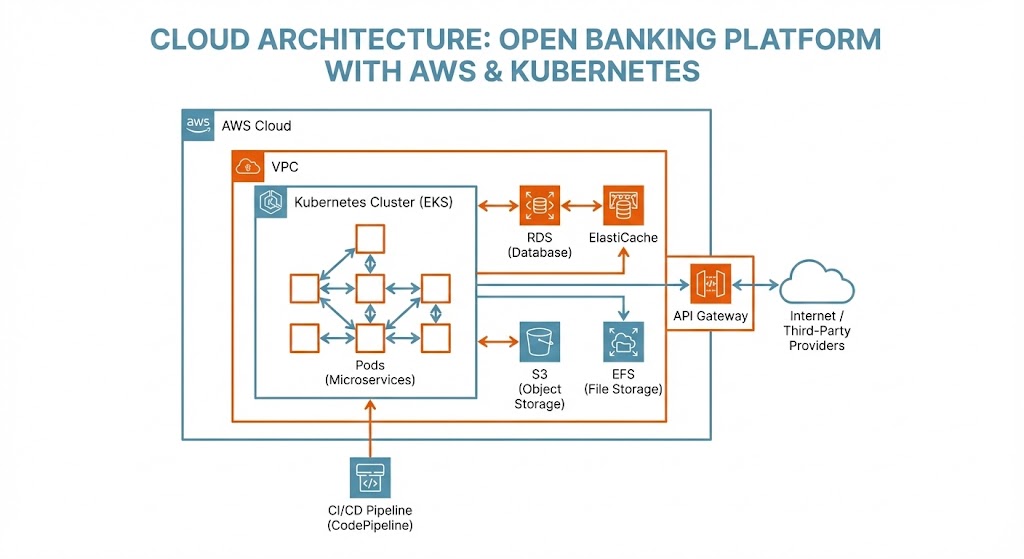
Cloud Infrastructure Migration for Open Banking Platform (Eurobits/Tink/Visa)
Management of complete infrastructure migration from on-premise to cloud (IBM Cloud and AWS) for an Open Banking platform. Design of modern cloud architectures, migration of hundreds of servers, and legacy infrastructure support during transformation process in a highly regulated international environment.
Comments
Submit comment